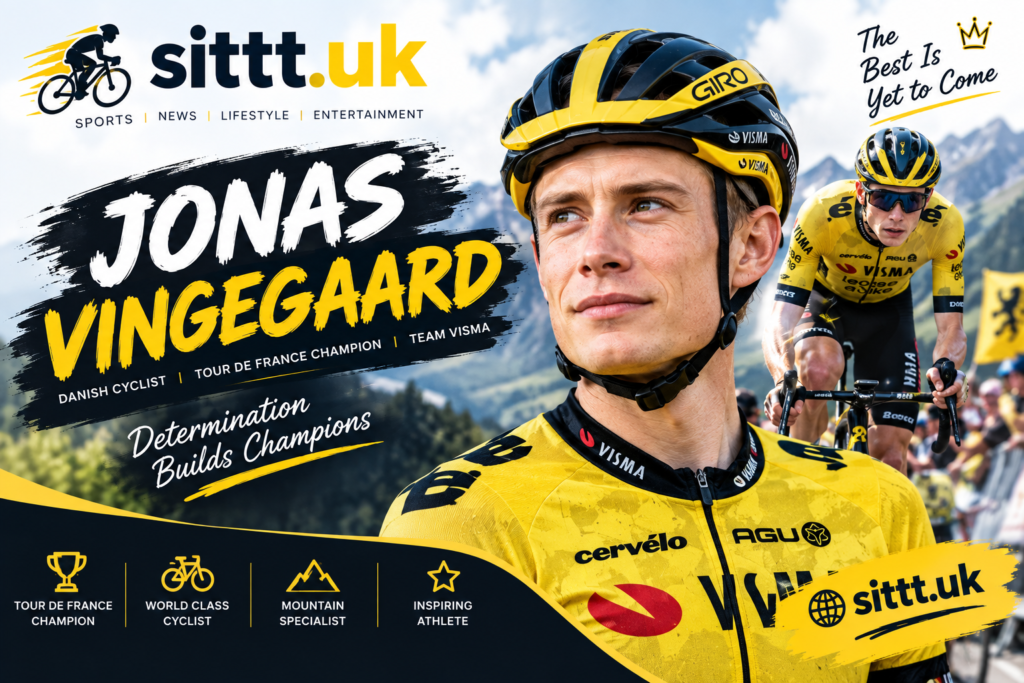

Few riders in modern cycling have travelled a stranger road to greatness than Jonas Vingegaard. He came from a village of a few hundred people on the windswept coast of northern Denmark, spent his mornings skinning fish in a factory while chasing a professional contract, and within six years was standing on the top step in Paris. By the summer of 2026 he had won all three of cycling’s Grand Tours, a feat achieved by only seven men before him in more than a century of racing. He has also broken his femur, his collarbone twice, several ribs and punctured a lung along the way. His career is a study in talent, patience and an almost stubborn refusal to stay down.
Early Years in the Danish Countryside
Vingegaard was born on 10 December 1996 in Hillerslev, a small settlement in the Thy district of northwest Jutland, to Claus Christian Rasmussen and Karina Vingegaard Rasmussen. He grew up alongside a sister, Michelle, in a region better known for fishing boats and flat, wind-battered farmland than for bicycle racing. As a boy he played football and handball and gave little thought to the sport that would eventually define him.
That changed in August 2007, when he went with his father to watch the opening stage of the Tour of Denmark set off from nearby Thisted. The local cycling club had set up a stationary trainer at the roadside so spectators could feel what it was like to ride uphill against resistance. The ten-year-old tried it, was captivated, and joined the club shortly afterwards. He rode for them for five seasons before moving on to clubs in Aalborg and Odder as he grew older, and for a long time nobody would have picked him out as a future champion.
The Long Road to the Professional Ranks
His transition into senior racing was difficult. Results dried up, motivation wavered, and there was a period when he considered walking away from the sport altogether. Things only began to turn in 2016, when his club formed a development squad and he finally found form, taking a podium in Aalborg and a win on a hilly course at Hammel in the spring.
That was enough to earn him a contract with a small Danish team, and with it came one of the most-told stories in cycling. To give his days some structure, his new manager arranged a job for him at a fish factory in Hanstholm. Vingegaard worked from six in the morning until noon, preparing fish for market, then trained through the afternoons. The nickname that followed him ever afterwards, the Fisherman, was never a marketing invention. Italian fans have since given him a grander version of the same idea, calling him the Fisher King.
Then came a setback that might have finished a less determined rider. In 2017 he crashed and broke his femur, losing most of a season at an age when young riders are supposed to be proving themselves. He came back stronger. On a training camp in Spain in early 2018 he set a record time on a well-known test climb, beating a mark held by an established Tour de France professional, and shortly afterwards a physiological assessment in Denmark found that his cardiac capacity sat roughly fifteen per cent above the national average for male cyclists. The larger teams began to take notice, and in 2019 he joined the Dutch squad that would become Visma–Lease a Bike, where he remains to this day.
Two Tours de France and a National Celebration
His first years at the highest level were spent in service of others. He rode his debut three-week race in Spain in 2020 as a helper, and arrived at the 2021 Tour de France as a support rider rather than a leader. When his team leader crashed out, Vingegaard inherited the responsibility almost by accident and finished second overall, becoming the first Dane on the podium in twenty-five years.
The following summer he went one better. On a brutal mountain stage over the Col du Granon he attacked with five kilometres remaining and put nearly three minutes into the defending champion, seizing the leader’s jersey. He sealed the victory days later on the Hautacam and rode into Paris as champion, having also won the mountains competition and set a record for the fastest average speed across an entire Tour. Denmark, which had hosted the race’s opening stages in Copenhagen that year, erupted. He returned home to a hero’s welcome and was named the country’s sporting personality of the year.
In 2023 he defended the title in even more emphatic fashion. The race had been finely balanced until a short time trial in the third week, where Vingegaard produced what many observers still regard as one of the greatest efforts in the history of the event, finishing well over a minute clear of his closest rival. The next day, on a savage Alpine climb, he took several minutes more. He won by more than seven minutes and was named the best rider in the world for that season.
The Rivalry That Defined an Era
For five consecutive editions of the Tour de France, from 2021 to 2025, Vingegaard and the Slovenian Tadej Pogačar occupied the top two places. No other pairing in the modern history of the race has dominated so completely or for so long. Pogačar won in 2021, 2024 and 2025; Vingegaard in 2022 and 2023.
What makes the rivalry compelling is how differently the two men are built. Pogačar has the greater raw power, an advantage that tells most on flat roads, in crosswinds and against the clock. Vingegaard’s strengths are his extraordinary power relative to his slight frame, his patience, and the collective discipline of a team that has repeatedly ridden its rivals into the ground in the high mountains. There has also been genuine warmth between them. When Pogačar crashed on a descent in 2022, Vingegaard eased off and waited for him rather than pressing the advantage, a gesture that set the tone for everything that followed.
Victory in Spain and a Finish Like No Other
In 2025, with Pogačar absent, Vingegaard finally won the Spanish Grand Tour, becoming the first Dane ever to do so. He took the lead early, lost it briefly, reclaimed it in the second week and defended it the rest of the way, winning three stages and sealing the overall on a punishing mountain finish outside Madrid on the penultimate day.
The conclusion was unlike anything the sport had seen in decades. Political demonstrations had disrupted the race repeatedly over its final two weeks, and on the closing day protesters overwhelmed the finishing circuit in the capital. With roughly fifty kilometres still to ride, organisers halted proceedings, cancelled the stage outright and abandoned the podium ceremony. Vingegaard shook hands with his teammates on an anonymous stretch of road and was driven away in a team car. He later described the situation as a great shame, saying a moment he would have remembered for the rest of his life had simply been taken from him.
Completing the Set in Italy
The following May he travelled to Italy for the first time as a three-week contender, and produced the finest sustained performance of his career. After losing significant time in an early time trial, he dismantled the race in the mountains, winning five stages in all and breaking long-standing climbing records on several of them, including one that had stood since the late 1990s. He took the leader’s jersey in the second week and extended his advantage steadily until it stood at more than five minutes.
In doing so he became only the eighth rider in history to win all three of cycling’s Grand Tours, and the first to complete the set in eight years. It was also, quietly, the one column in which he had moved ahead of his great rival, who had not yet done the same.
The Crash That Ended the Season
His 2026 season had been close to flawless. He had won two major week-long stage races in the spring, then the Italian Grand Tour, and had opened the Tour de France by leading his team to victory in the opening team time trial in Barcelona, pulling on the leader’s jersey for the first time in three years.
It ended abruptly on 19 July. Sitting second overall, Vingegaard clipped a kerb on a bend roughly twenty kilometres from the finish of a mountain stage and slid heavily onto the roadside. Several other riders went down with him and all remounted; he did not. He was taken away by ambulance with his arm in a sling, and scans confirmed a fractured collarbone requiring surgery. It was the first time he had ever abandoned the race.
The crash was made more controversial by the fact that anti-doping officials had woken him at two in the morning that same day to provide a sample, an unusual hour that provoked considerable anger in the peloton. It later emerged that the testing had been authorised in advance by a French judge under a rarely used legal procedure. No wrongdoing has been established on anyone’s part, and Vingegaard himself declined to blame the disturbed night for the fall, observing simply that crashes are part of bike racing.
In August his team confirmed that his recovery had delayed his training too severely for him to return to competitive form before the winter, and his season was declared over. Rumours of a late autumn comeback surfaced in September and were firmly dismissed.
The Man Behind the Numbers
Vingegaard stands just under one metre seventy-six and races at somewhere close to sixty kilograms, a build that explains his ability to float away from larger men on steep gradients. Estimates drawn from his climbing performances put his sustainable power at around six and a half watts per kilogram for efforts lasting more than half an hour, figures that were the preserve of theory a generation ago.
He rides bicycles made by the Canadian manufacturer Cervélo, increasingly favouring the aerodynamic model even on mountainous days, and has been one of the peloton’s most visible experimenters with unusually short cranks, at one point using a length no professional had been seen on before. He is also the only member of his team to wear a red and white helmet rather than the standard yellow, a detail that puzzles many viewers. The explanation is straightforward commerce: it reflects a partnership with a Danish building supplies company whose colours happen to match the national flag.
His earnings have risen as steeply as his results. Reports suggest he was on a modest salary when he won his first Tour, and that within four years he had become one of the three best-paid riders in the sport, on a figure widely estimated at around five million euros a year. He is under contract until the end of 2028.
Family Life and Life at Home
Vingegaard is married to Trine Marie Hansen, whom he met while riding for the small Danish team that first gave him a professional contract, where she worked in marketing. They married in the northern Danish town of Glyngøre, where he still lives, and in 2024 he took her surname, having previously carried his father’s. They have two children, a daughter born in 2020 and a son born in 2024. He has spoken often about dedicating his biggest victories to them, and has largely kept his private life out of public view.
When the Tour of Denmark began a stage in Glyngøre in the summer of 2026, he turned up as a spectator while still recovering, describing it as something genuinely special to watch a bike race in his own hometown and to let his teammates see the roads he trains on.
What Lies Ahead
He turns thirty in December, and the combination of that milestone, a contract expiring in 2028 and a long list of serious injuries has fuelled speculation that he may not race for many more years. He has addressed the question directly and dismissed it, saying he has made no decision, that he may continue beyond 2028, and that what motivates him most is the number of races he has still never won. He has also ended talk of a move elsewhere, confirming he intends to stay with the team that has supported him since 2019.
His specific targets for the coming season will depend on how his recovery progresses, but the broad intention is clear enough: to fill the remaining gaps in a record that is already among the most impressive of the modern era.
Conclusion
Jonas Vingegaard’s career resists easy summary. He is a rider of enormous physiological gifts who was overlooked for years, a champion who has spent almost as much time recovering from crashes as celebrating victories, and a fiercely private man who has become one of the most recognisable faces in Danish public life. He has won the Tour de France twice, the Spanish Grand Tour once and the Italian one on his first attempt, and he has done it all while sharing an era with a rider many consider the most gifted in history.
The image that lingers from 2026 is not the leader’s jersey or the record-breaking climbs, but a man sitting at the roadside in his hometown with his arm still healing, telling a tearful young supporter that he was not going to stop riding. On the evidence of everything that came before it, there is little reason to doubt him.
You May Also Read : Strands is the New York Times